

Agricultural Microbials Market to Reach US$ 28.52 Billion by 2035 as Sustainable Farming Accelerates with CAGR of 14.85%
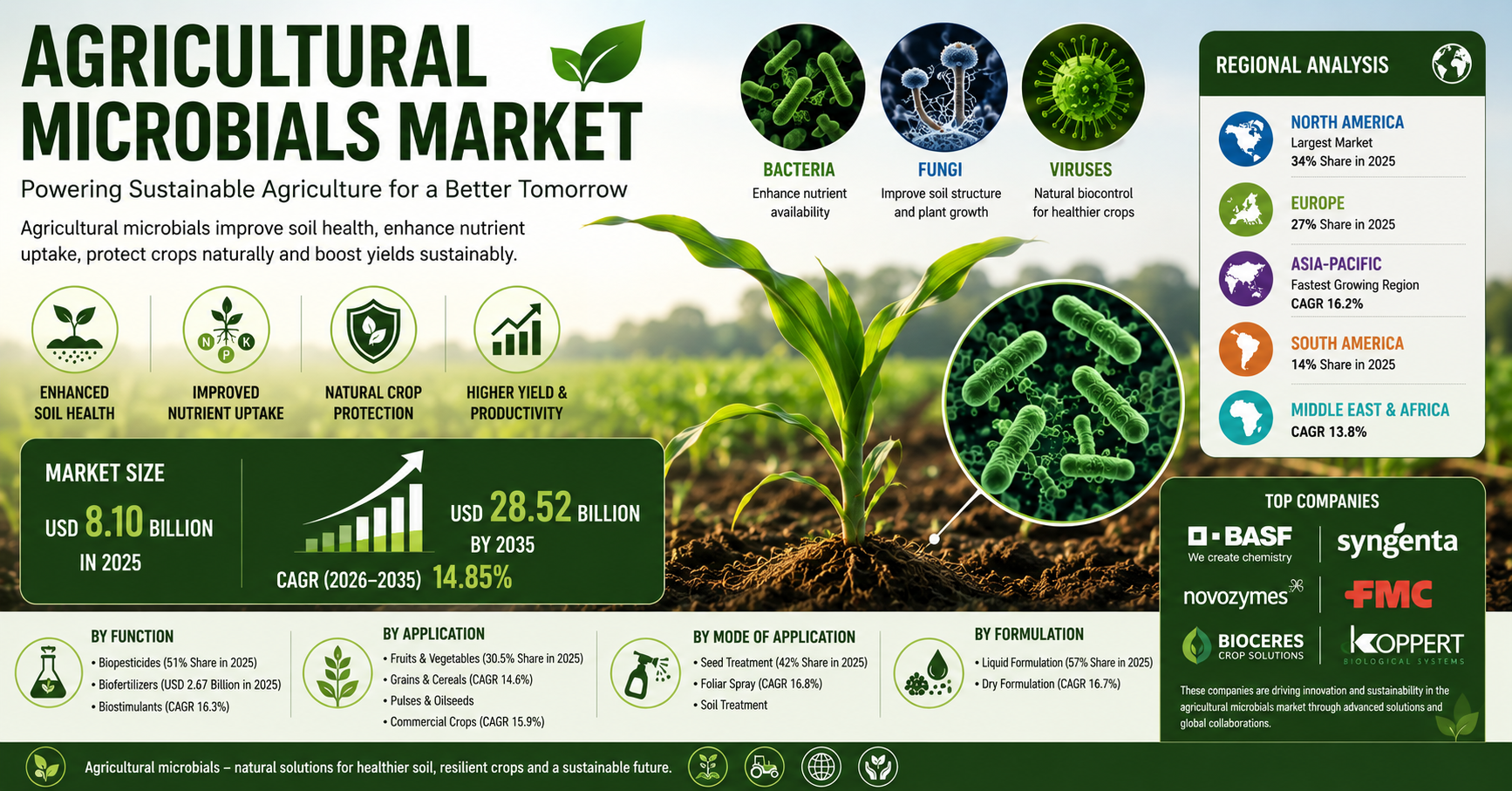
Agricultural Microbials Market
Agricultural microbials—comprising bacteria, fungi, viruses, and protozoa—are gaining widespread acceptance as environmentally friendly alternatives to synthetic fertilizers and pesticides. These biological solutions improve soil fertility, enhance nutrient uptake, and offer effective pest and disease management while minimizing ecological impact.
Latest Trends Shaping the Agricultural Microbials Market:
One of the most prominent trends influencing the market is the increasing adoption of residue-free agricultural practices. With global food safety regulations becoming more stringent, farmers are transitioning from chemical-based inputs to microbial solutions that align with Maximum Residue Limit (MRL) standards. This trend is particularly evident in export-driven agriculture, especially in fruits and vegetables, which account for approximately 30.5% of the market’s application share in 2025.
Another significant trend is the rapid integration of microbial products into precision agriculture systems. Advanced delivery methods, such as drone-based foliar spraying and seed treatment technologies, are improving the efficiency and consistency of microbial applications. The foliar spray segment is expected to grow at a CAGR of 16.8% through 2035, highlighting the increasing role of technology in modern farming.
Additionally, the rise of liquid formulations—holding around 57% of the market share in 2025—is driven by their ease of application and compatibility with existing agricultural equipment. Dry formulations, on the other hand, are gaining traction in tropical regions due to their longer shelf life and logistical advantages.
Market Drivers and Opportunities:
The Agricultural Microbials Market is primarily driven by escalating input costs associated with synthetic fertilizers, which have witnessed significant inflation in recent years. This cost pressure has encouraged farmers to explore cost-effective and sustainable alternatives such as biofertilizers and biostimulants. Biofertilizers alone accounted for USD 2.67 billion in 2025, reflecting their growing importance in nutrient management.
Environmental concerns and government initiatives promoting sustainable agriculture are also acting as key growth catalysts. Policies aimed at reducing chemical usage and improving soil health are accelerating the adoption of microbial solutions across both developed and emerging economies.
Moreover, climate change is creating new opportunities for microbial-based products. Biostimulants, which are projected to grow at a CAGR of 16.3%, are increasingly used to enhance plant resilience against abiotic stresses such as drought, salinity, and extreme temperatures.
Another major opportunity lies in the expansion of commercial crops such as cotton and sugarcane. These crops are witnessing increased adoption of microbial products due to their ability to reduce input costs and improve yield efficiency, with this segment expected to grow at a CAGR of 15.9%.
Segment Analysis:
1. By Function
The market is segmented into biopesticides, biofertilizers, and biostimulants. Among these, biopesticides dominate the market, accounting for approximately 51% of total revenue in 2025. This dominance is attributed to stricter pesticide regulations and the growing need for eco-friendly crop protection solutions.
Biofertilizers are gaining traction due to their role in enhancing soil fertility and reducing dependency on chemical fertilizers. Meanwhile, biostimulants are emerging as the fastest-growing segment, driven by their ability to improve crop yield and resilience under changing climatic conditions.
2. By Application
In terms of application, fruits and vegetables hold the largest share, driven by high-value crop production and export requirements. Grains and cereals are expected to witness significant growth, registering a CAGR of 14.6%, due to increasing adoption of nitrogen-fixing microbial solutions in staple crops such as wheat and corn.
Pulses and oilseeds also represent a substantial segment, supported by the established use of inoculants like Bradyrhizobium. Commercial crops are emerging as a high-growth segment, driven by the economic benefits of microbial inputs.
3. By Mode of Application
Seed treatment is the leading mode of application, accounting for approximately 42% of market share in 2025. This method ensures efficient delivery of microbial agents at the early stages of crop growth.
Foliar spray is expected to witness the fastest growth, supported by advancements in precision agriculture technologies. Soil treatment remains a critical segment, particularly for improving soil health and restoring microbial balance.
4. By Formulation
Liquid formulations dominate the market due to their ease of use and compatibility with modern agricultural equipment. Dry formulations are expected to grow at a CAGR of 16.7%, driven by their longer shelf life and suitability for diverse climatic conditions.
Regional Analysis:
1. North America
North America holds the largest market share, accounting for approximately 34% of global revenue in 2025. The region’s dominance is attributed to early adoption of advanced agricultural technologies and strong regulatory support for sustainable farming practices.
2. Europe
Europe represents around 27% of the market and is driven by stringent environmental regulations and initiatives such as pesticide reduction programs. The region’s focus on organic farming and sustainable agriculture is fueling the demand for microbial products.
3. Asia-Pacific
Asia-Pacific is the fastest-growing region, with a projected CAGR of 16.2% during the forecast period. Government subsidies, increasing awareness of sustainable farming, and large-scale agricultural activities in countries like China and India are driving market growth.
4. South America
South America accounts for approximately 14% of the market, with Brazil leading the region due to widespread adoption of microbial inoculants in soybean cultivation.
5. Middle East & Africa
The Middle East & Africa region is expected to grow at a CAGR of 13.8%, supported by increasing investments in agricultural technologies and the need to address water scarcity and soil degradation.
Request for PDF Sample: https://www.marketresearchfuture.com/sample_request/5410
Top Company Profiles:
The Agricultural Microbials Market is characterized by the presence of several key players focusing on innovation, product development, and strategic collaborations. Leading companies are investing heavily in research and development to enhance the efficacy and shelf life of microbial products.
Key players in the market include:
1. BASF SE is a global leader in agricultural solutions, offering a wide range of biological crop protection and soil health products. The company emphasizes sustainable agriculture by integrating microbial technologies with digital farming solutions to optimize crop productivity and environmental performance.
2. Syngenta Group plays a pivotal role in advancing biologicals through continuous innovation and strategic acquisitions. Its agricultural microbials portfolio focuses on enhancing crop resilience and yield while supporting sustainable farming practices worldwide.
3. Novozymes A/S is a pioneer in bio-innovation, specializing in microbial-based solutions for agriculture. The company’s strong expertise in enzyme and microbial technologies enables it to deliver high-performance biofertilizers and biostimulants that improve nutrient efficiency and soil health.
4. FMC Corporation is actively expanding its biologicals segment, leveraging advanced research capabilities to develop eco-friendly crop protection solutions. The company is focused on integrating microbial technologies into mainstream agriculture to reduce reliance on synthetic chemicals.
5. Bioceres S.A. is recognized for its innovative approach to sustainable agriculture, particularly in developing microbial seed treatments and crop nutrition solutions. The company is committed to enhancing productivity while addressing environmental challenges.
6. Koppert Biological Systems is a well-established player in biological crop protection and pollination services. Its strong focus on natural solutions and integrated pest management has positioned it as a trusted partner for growers seeking sustainable alternatives.
These companies are shaping the future of the Agricultural Microbials Market by driving technological advancements, expanding global reach, and addressing the growing demand for environmentally sustainable farming solutions.
Recent Developments:
January 2026: Leading agricultural biotechnology firms expanded their microbial product portfolios to address rising demand for sustainable crop protection solutions.
March 2026: Strategic collaborations between agri-tech companies and research institutions accelerated the development of next-generation microbial formulations.
June 2026: Increased investments in precision agriculture technologies enhanced the efficiency of microbial application methods, particularly in foliar spraying and seed treatment.
September 2025: Major players introduced innovative biofertilizer products aimed at improving nutrient uptake and soil health.
November 2025: Expansion of production facilities by key market participants supported the growing global demand for microbial-based agricultural inputs.
Conclusion:
The Agricultural Microbials Market is poised for substantial growth over the next decade, driven by the global transition toward sustainable agriculture, increasing regulatory pressure on chemical inputs, and the need for improved crop productivity. With advancements in technology, expanding application areas, and strong support from governments and industry stakeholders, agricultural microbials are set to play a pivotal role in shaping the future of farming.
As the market continues to evolve, companies that focus on innovation, scalability, and sustainability will be well-positioned to capitalize on emerging opportunities and drive long-term growth in this dynamic sector.
Sagar Kadam
Market Research Future
+1 628-258-0071
sales@marketresearchfuture.com
Visit us on social media:
LinkedIn
Facebook
X
Legal Disclaimer:
EIN Presswire provides this news content "as is" without warranty of any kind. We do not accept any responsibility or liability for the accuracy, content, images, videos, licenses, completeness, legality, or reliability of the information contained in this article. If you have any complaints or copyright issues related to this article, kindly contact the author above.
